
MBS Road Signs 12-1-2025

MBS Road Signs 11-24-2025
Week of November 24, 2025 in Review
September brought a slight slowdown in annual home price gains, yet October’s pending home sales hit a yearly high. Plus, the government released previously delayed September data on retail sales and wholesale inflation. Here’s a look at the key highlights.
Home Prices Still Up Year-Over-Year, but Pace Slows
Pending Home Sales Rise in October
Persistent Continuing Claims Highlight Slower Hiring
September Retail Sales Show Shoppers Pulling Back
Energy Prices Fuel Rise in Wholesale Inflation
What to Look for This Week
Technical Picture
Home Prices Still Up Year-Over-Year, but Pace Slows
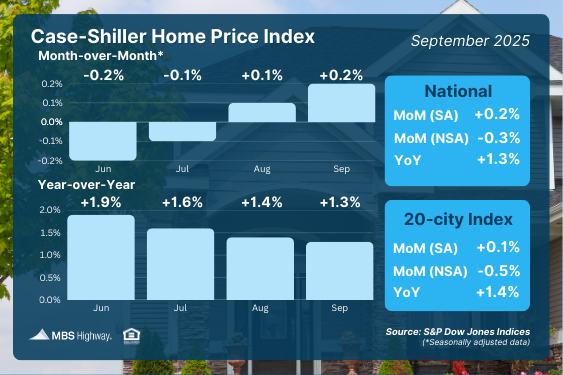
The Case-Shiller Home Price Index – one of the most widely followed gauges of U.S. home values – showed a 0.3% monthly decline from August to September before seasonal adjustments, but a 0.2% increase after adjusting for seasonality. Nationally, prices are still 1.3% higher than a year ago, a slight dip from August’s 1.4% annual gain.
The FHFA Index, which tracks homes financed with conventional mortgages and excludes cash and jumbo purchases, reported seasonally adjusted prices were flat month-to-month. Year over year, prices were up a somewhat stronger 1.7%.
What’s the bottom line? Home prices remain above last year’s levels, but appreciation has cooled. If mortgage rates continue to fall, buyer demand could strengthen and potentially push prices higher again.
Pending Home Sales Rise in October
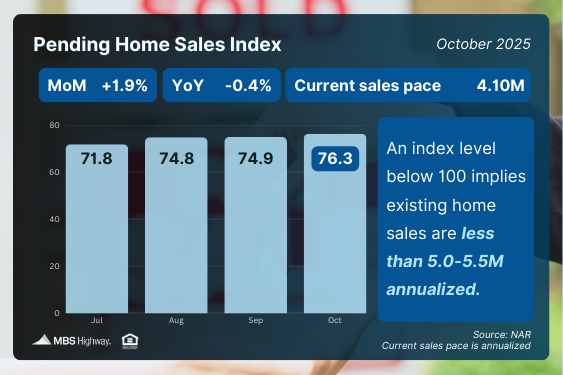
Pending Home Sales rose 1.9% from September to October, beating expectations and reaching their strongest pace of the year, according to the National Association of REALTORS® (NAR). Contract signings were down only 0.4% compared to a year ago.
What’s the bottom line? Because Pending Home Sales lead closings by one to two months, October’s gain suggests we’ll see a higher volume of finalized transactions in the coming months. Easing mortgage rates and rising inventory are clearly helping bring buyers back into the market.
Persistent Continuing Claims Highlight Slower Hiring
Initial jobless claims fell by 6,000 to 216,000 in the latest week, marking their lowest level in two months. However, continuing claims – people receiving benefits beyond the first week – rose by 7,000 to 1.96 million, one of the highest readings in four years.
What’s the bottom line? Even as initial claims remain relatively low, the sustained rise in continuing claims – above 1.9 million since mid-May – signals that displaced workers are taking longer to land new jobs. This points to a cooling labor market.
September Retail Sales Show Shoppers Pulling Back
After delays caused by the shutdown, the government released September retail sales data, showing a modest 0.2% increase – below expectations and well under August’s stronger 0.6% gain.
The “control group,” which excludes autos, gas, building materials and food services, slipped 0.1%. This marked its first decline in five months and matters because it feeds directly into GDP calculations.
What’s the bottom line? September’s softer spending suggests consumers may have started to cool heading into the fourth quarter. The delayed October and November reports will be key to understanding whether this slowdown has become a trend.
Energy Prices Fuel Rise in Wholesale Inflation
The government also released delayed September Producer Price Index data, showing wholesale prices rose 0.3% from August and 2.7% year over year – both in line with expectations and largely driven by a nearly 12% jump in gasoline prices.
Core producer prices, which exclude food and energy, increased 0.1% on the month and 2.6% annually, both slightly below forecasts.
What’s the bottom line? Wholesale prices feed directly into the Fed’s preferred inflation gauge, the Personal Consumption Expenditures (PCE) index. While some shared components – such as airline fares and nursing home care – rose, others, including portfolio management and hospital outpatient services, declined. Overall, this report isn’t expected to spark a meaningful increase in the September PCE reading, now scheduled for release on December 5.
What to Look for This Week
It’s jobs week, and although the JOLTS data and the monthly Jobs Report from the Bureau of Labor Statistics have been delayed due to the shutdown, we’ll still get ADP’s November Employment Report on Wednesday and the latest Jobless Claims on Thursday.
Then on Friday, the delayed September Personal Consumption Expenditures report arrives – a key release, given that it’s the Fed’s preferred inflation gauge.
Technical Picture
Mortgage Bonds ended last week trading in a new range, with support at 101.17 and resistance at 101.44. The 10-year yield continues to test the critical 4% floor, and a convincing break below it could see yields retest 3.95%.